
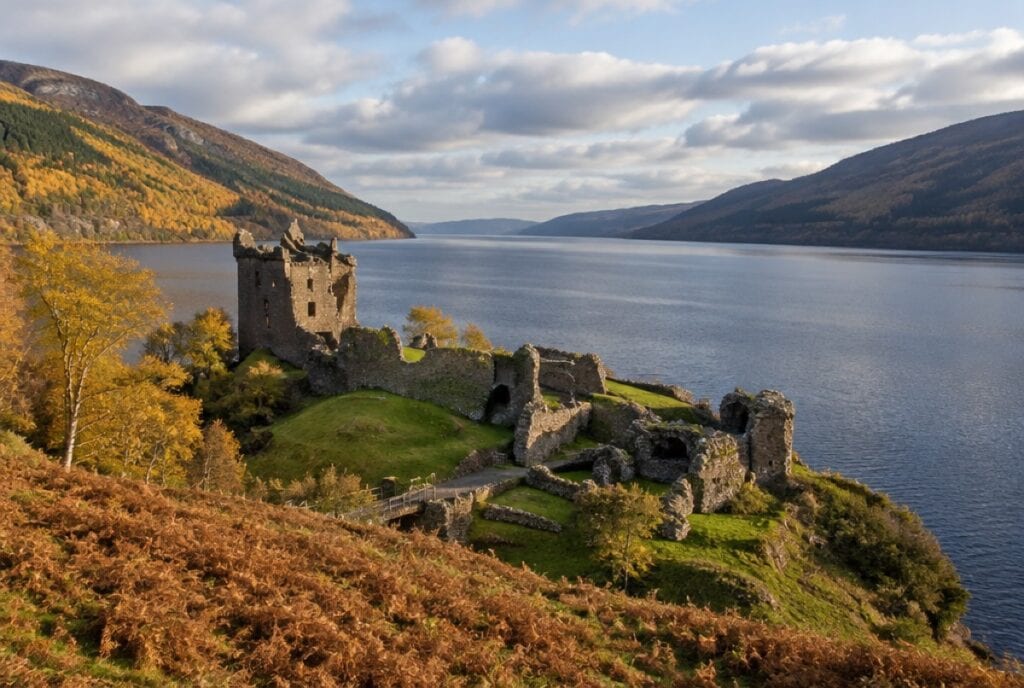
Loch Ness is the place guests ask about most, often before they have worked out anything else about their trip. It is also the one I am most careful to plan honestly. The loch is a long way from Edinburgh, and whether it makes a good day or a tiring one depends on the route, the season and what you want to see when you get there.
How far is Loch Ness from Edinburgh?
Drumnadrochit, the village beside Urquhart Castle, is about 170 miles from Edinburgh. The usual route goes north on the A9 through Perthshire to Inverness, then down the A82 along the loch. Without stops, that is roughly three and a half to four hours each way.
There is a second route. You can go west past Loch Lomond and through Glencoe to Fort William, then follow the Great Glen to Fort Augustus at the southern end of the loch. It is a similar distance and takes a little longer, but the scenery through Rannoch Moor and Glencoe is some of the finest in the country.
So a return day trip means seven to eight hours of driving before you have stopped for anything. That is the number I want every guest to see before they decide.
What a day trip from Edinburgh looks like
A day trip works, and plenty of my guests enjoy one. It suits people who are short on time and would rather see Loch Ness once than miss it.
On a typical day I collect guests around 7am and take the A9 north. Pitlochry, about an hour and three quarters in, is a good place for coffee and a walk. We reach the loch in the early afternoon and spend most of our time around Drumnadrochit: Urquhart Castle first, then a short drive along the shore for the views down the Great Glen. We head home in the late afternoon and are back in Edinburgh in the evening.
It is a long day, roughly 12 hours door to door. In a private car you can sleep, talk or simply watch the Cairngorms go by, which makes a real difference compared with a full coach. But you only see one corner of the loch.
Why I often suggest a night away
With one night near the loch, the trip changes completely. You can go up the A9 and come back through Glencoe, so you never drive the same road twice. You have time for the parts of Loch Ness that day trips skip:
- Fort Augustus, where the Caledonian Canal meets the loch and you can watch boats working through the locks in the middle of the village
- The south side of the loch, a quiet single-track road through Foyers, where the Falls of Foyers drop about 140 feet through the woods, and Dores, with its shingle beach and long views down the water
- A cruise on the loch. Boats run from Drumnadrochit, Fort Augustus and near Inverness, and some trips drop you at Urquhart Castle
I usually suggest staying in Inverness, which has the widest choice of hotels and restaurants, or in one of the villages on the loch if you want somewhere quieter.
Urquhart Castle: book ahead
Urquhart Castle is the stop almost everyone wants, and it is worth planning around. It sits on a headland on the western shore about two miles from Drumnadrochit, and the view down the loch from the tower is the one you will have seen in photographs.
Historic Environment Scotland advises booking tickets online in advance. Its own Urquhart Castle page warns that tickets often sell out in summer and that none are sold at the castle once they have gone online. Parking is free but only guaranteed with an advance booking. From November to March the castle opens 9.30am to 4.30pm, with last entry an hour before closing.
I check the times and book for my guests once the date is fixed.
Visiting in autumn and winter
Late autumn is one of my favourite times on the loch. The birch and bracken on the hillsides turn gold and rust, and there are far fewer people at the castle.
Winter needs more thought. In December the sun rises around 9am in Inverness and sets around 3.30pm. On a day trip you would drive both ways in the dark and have about six hours of light at the loch. If you are visiting between November and February, I would almost always suggest staying a night. Winter weather in the Highlands can also close roads or attractions at short notice, so I keep an eye on the forecast and have a plan B ready.
A few facts guests like to know
Loch Ness is about 23 miles long and, at its deepest, about 230 metres (754 feet). It holds more fresh water than all the lakes in England and Wales combined. The water stays cold all year and rarely goes above 13°C.
As for Nessie, I have driven that road many times and not met her yet. I will keep looking on your behalf.
Planning your Loch Ness trip
If you are deciding between a day trip and a night away, the honest answer depends on your dates and how much of the Highlands you want to see. My Highlands day trips post compares the routes north in more detail, and my private tours page shows how I put longer trips together.
Frequently asked questions
Can you do Loch Ness in a day from Edinburgh?
Yes, but it is a long day of around 12 hours, with seven to eight hours of driving. It works best in spring and summer, when there is enough light to enjoy the loch.
What is the best route from Edinburgh to Loch Ness?
The A9 through Perthshire is the quickest. The route through Glencoe and Fort William is the more scenic. With a night away, I take one route out and the other back.
Do I need to book Urquhart Castle in advance?
Historic Environment Scotland recommends it. Summer tickets often sell out online, and none are sold at the castle once they have gone. Parking is only guaranteed with an advance booking.
Can you take a boat trip on Loch Ness in winter?
Some operators run cruises all year, apart from a few days over Christmas and New Year. I check the timetable and book for you, because winter sailings are fewer.
Is Loch Ness worth visiting in winter?
Yes, if you stay a night. The loch is quiet and dramatic in winter light, but short days make a same-day return from Edinburgh mostly a drive in the dark.
If Loch Ness is on your list, send me a note with your dates and how many of you are travelling. I’ll tell you plainly whether a day trip or a night away suits you better.

