
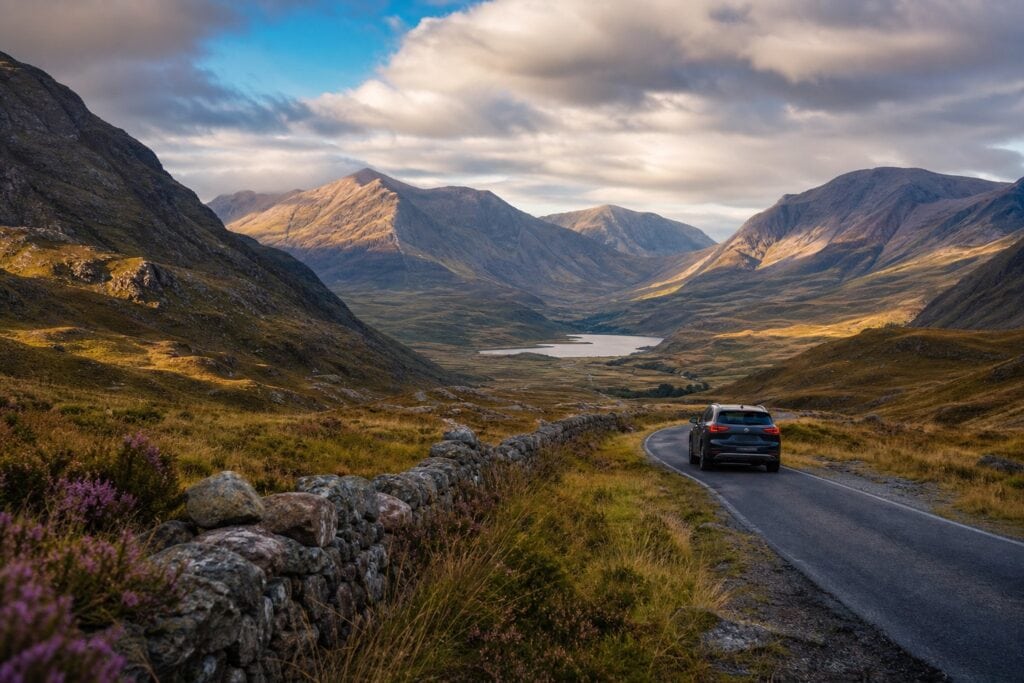
Planning a trip to Scotland and thinking about hiring a car (or renting a car, as most of our American and Canadian guests would say)?
For many visitors from the USA and Canada, having a car rental is a great way to see more of Scotland. It gives you the freedom to explore the Highlands, visit castles and distilleries, discover smaller towns and villages, and stop when you see somewhere you’d like to take a closer look.
But hiring a car in Scotland is a little different from hiring one at home.
You will be driving on the left, dealing with roundabouts, giving way to the right, and may find yourself on roads that are considerably narrower than those you’re used to. There are also a few things to understand about the hire car itself, including insurance, deposits, excesses and choosing the right size of vehicle.
Although this guide is written with our American and Canadian guests in mind, much of the advice will also be useful for visitors from any country where driving on the right is the norm.
At Saltire Executive Travel, we regularly help visitors arrange car hire as part of their Scotland trip. Here are some of the things we think you should know before you book.
Do You Need a Hire Car for Your Whole Trip?
Not necessarily.
If you’re spending a few days in Edinburgh, you may find that you don’t need a car at all. Parking can be very limited and expensive, also getting around the city without a car is often easier.
If you’re planning to head into the Highlands, visit Skye, explore Speyside, visit distilleries, see castles and lochs or travel to some of Scotland’s smaller towns and villages, having a car can give you much more freedom.
For some trips, it makes sense to spend your first few days in Edinburgh without a car and then collect one when you’re ready to leave the city.
It can also be worth thinking about when you’ll actually need the car rather than simply hiring one for the entire holiday.
There isn’t one right answer. It depends on where you’re going, how long you’re staying and what you’d like to see.
Where Should You Pick Up Your Hire Car?
The best place to collect your car will depend on your itinerary.
You may be arriving at Edinburgh or Glasgow Airport, starting your trip in one of the cities, or flying into somewhere such as Inverness or Aberdeen.
You might also want to collect the car in one place and return it somewhere else.
Before booking, think about where you’ll be staying, where you are heading next and how much time you’ll actually spend driving.
For example, if you’re spending three days in Edinburgh before heading north, there may be little point in paying for a hire car while it is sitting outside your hotel.
The collection and return locations available, and any one-way charges, will depend on the rental company and the dates of your trip.
Which Car Hire Company Should You Use?
This is one of the questions visitors ask most often, whether you call it hiring a car or renting one.
The honest answer is that there isn’t one company that is always the best choice for everyone.
Prices and availability can change depending on the time of year, where you’re collecting the car, where you’re returning it and what type of vehicle you need.
Don’t just look at the headline rental price.
Before you book, check:
What is included in the price?
How much is the security deposit?
What is the insurance excess?
What is the fuel policy?
Is there a mileage limit?
Are additional drivers included?
Is there a one-way charge?
What happens if you need to cancel?
What are the collection and return arrangements?
What type of vehicle are you actually booking?
The cheapest price you see at first isn’t necessarily the cheapest option once all the extras have been added. GOV.UK also recommends checking the excess and deposit carefully before booking. (GOV.UK)
Automatic or Manual?
This is an important one for visitors from North America.
Most cars in the USA and Canada are automatic, while manual cars are still common in the UK.
If you aren’t comfortable driving a manual car, book an automatic.
Don’t assume you can simply change to an automatic when you arrive. Availability can be more limited, particularly during busy periods.
If you are comfortable driving a manual, you’ll generally have more vehicles to choose from.
What Size Car Should You Hire?
Bigger isn’t always better in Scotland.
You may be used to choosing a larger vehicle at home, but a smaller car can be much easier to drive and park on Scottish roads.
Think about:
How many people are travelling?
How many large suitcases do you have?
How much hand luggage will you have?
Will you need child seats?
Where will you be driving?
Will you be travelling on narrow country roads?
Where will you be parking?
If you’re planning to drive through the Highlands, smaller roads can be much narrower than many visitors from North America are used to.
At the same time, don’t choose a car that is too small for your passengers and luggage.
A car that is advertised as suitable for four people doesn’t necessarily mean four adults can comfortably travel with four large suitcases.
Check the Luggage Space
This is easy to overlook when booking online.
Hire cars are normally offered by vehicle category, and the exact make and model can vary.
A car that looks large enough in a photograph may have less boot space than you expect.
If you’re travelling with several large suitcases, tell the person arranging the car. The number of passengers and the amount of luggage can make a big difference to the vehicle category you need.
Understanding Insurance, Excess and Deposits
Car hire insurance can be confusing, particularly if you’re used to a different system at home.
One term you’ll often see is excess.
The excess is the amount you could be responsible for in certain circumstances if the hire car is damaged or stolen, depending on the terms of your rental agreement and the cover you’ve chosen.
The deposit is different. This is money that may be held or ring-fenced on your payment card during the rental period.
Before you collect the car, make sure you understand:
What insurance is included
How much the excess is
How much deposit is required
What additional cover is available
What is excluded
What you would need to pay if the vehicle was damaged
Don’t choose a hire car simply because the daily price looks cheap. Make sure you understand what you’re actually paying for. GOV.UK specifically advises customers to check the excess and deposit when comparing hire cars. (GOV.UK)
Can American and Canadian Visitors Drive in Scotland?
Visitors can usually drive in Scotland using a valid driving licence from their home country, although requirements can vary depending on where the licence was issued.
Always check the current UK Government guidance and the requirements of the individual hire company before travelling. VisitScotland also advises visitors to check the UK Government guidance because requirements can vary depending on where the licence was issued. (VisitScotland)
You may also need to meet the rental company’s requirements relating to age, payment cards and additional drivers.
It is much better to check these things before you travel than discover there is a problem when you arrive at the rental desk.
The Biggest Adjustment: We Drive on the Left
This is probably the most important thing for visitors from the USA, Canada and other countries where driving on the right is normal.
In Scotland, we drive on the left-hand side of the road.
It sounds simple, and most visitors get used to it quite quickly.
The tricky moments are often when you aren’t thinking about it.
Turning out of a junction.
Leaving a petrol station.
Pulling out of a car park.
Entering a roundabout.
Setting off again after stopping.
When you’ve spent years driving on the right, your brain can sometimes fall back into old habits when you’re tired or concentrating on something else.
There is a good reason to take this seriously. Transport Scotland research into tourist collisions found that inexperience of driving on the left was recorded as a contributory factor in a large proportion of the tourist collisions studied. Some collisions involved tourists being on the wrong side of the road and colliding with oncoming traffic.
So our advice is simple:
Take your time, concentrate on the road and give yourself a chance to get used to driving on the left.
Your first few miles aren’t a race.
A Few Things That Can Help
When you collect your car, take a few minutes to get comfortable before setting off.
Make sure you know:
Where the lights are
How the windscreen wipers work
How the indicators work
Where reverse gear is, if you’ve hired a manual
How the parking brake works
How to adjust the mirrors
How to operate the sat-nav
Which side the fuel cap is on
And when you start driving, pay particular attention when turning.
A useful way to think about it is to look at the road and ask yourself where the traffic coming towards you should be. That can help reinforce which side of the road you need to be on.
And Then There Are Roundabouts!
If you’ve never driven in the UK before, roundabouts can take a little getting used to.
In Scotland:
We drive around roundabouts clockwise
You give way to traffic coming from your right
You enter from the left
Road markings and signs tell you which lane to use
You’ll find roundabouts are very common Scotland, so you’ll probably come across several during your trip. VisitScotland provides guidance for visitors on driving in Scotland and using the road system. (VisitScotland)
If you’re unsure, slow down, read the signs and give yourself time to work out where you need to go.
Driving on Scottish Roads
Once you leave the cities, the roads can change quite quickly.
You may encounter:
Narrow country roads
Single-track roads
Passing places
Sharp bends
Farm vehicles
Cyclists
Motorcyclists
Coaches and motorhomes
Sheep and other animals
Some of these roads can be very narrow.
That doesn’t mean you shouldn’t drive them. It just means you need to be prepared and take your time.
What Are Passing Places?
If you’re heading into the Highlands or Islands, you may come across single-track roads.
These roads are wide enough for traffic travelling in one direction, with passing places provided so vehicles travelling in opposite directions can pass safely.
If you see a vehicle coming towards you, one of you will need to use a passing place.
Take your time and be patient.
And one important point:
Passing places are for passing, not parking.
VisitScotland advises drivers to use passing places when needed, drive slowly and avoid parking in them. (VisitScotland)
If a vehicle is behind you and you have a suitable passing place, let it pass.
There’s no need to feel pressured. Just pull in safely when you can.
Don’t Underestimate Scottish Driving Times
This catches a lot of visitors out.
You might look at a map and think that two places aren’t very far apart, but the mileage doesn’t tell the whole story.
Some Highland roads are narrow and winding, and your average speed will be much lower than it might be on a motorway.
Give yourself plenty of time.
Don’t plan every day so tightly that you’re rushing from one place to another.
And remember that you’ll probably want to stop along the way.
Scotland has plenty of places where you’ll want to pull over, take a photograph or have a look around.
Just make sure you use a safe and suitable place to stop, not in a passing place.
Enjoy the Scenery, But Watch the Road
This sounds obvious, but it’s worth saying.
You’re probably coming to Scotland because you want to see the scenery.
We don’t blame you.
But if you see something you want to photograph, find somewhere safe to pull over.
Don’t stop in the road or slow down unexpectedly because you’ve spotted a castle, a loch, a Highland cow or a particularly good view.
Take the photograph after you’ve parked safely.
What About Driving in the Highlands?
Don’t be put off.
Driving in the Highlands can be a fantastic part of your Scottish holiday.
You just need to approach it differently from driving on a long, straight road at home.
Allow more time.
Take regular breaks.
Watch the road.
Be prepared for narrow sections.
And don’t worry if you have to slow down.
VisitScotland advises drivers to take care on narrow country roads and explains how passing places are used on single-track roads. (VisitScotland)
Be prepared, not nervous.
Should You Drive Straight From the Airport?
You can, but think about how you’ll feel after your flight.
If you’ve just arrived from North America after a long journey, you’ve got an unfamiliar car and you’re about to drive on the opposite side of the road from the one you’re used to.
For some people, that’s absolutely fine.
For others, it may be better to spend a couple of days in Edinburgh first and collect the car when they’re ready to leave the city.
There is no right or wrong answer.
Think about your arrival time, how tired you’ll be, where you’re staying and where you’re going next.
Before You Drive Away
Before you leave the hire car collection point:
Check the vehicle for existing damage
Make sure any damage has been recorded
Take photographs of the car
Check the fuel level
Adjust the mirrors and seat
Familiarise yourself with the controls
Make sure you know how the lights and wipers work
Check the parking brake
Check how the fuel flap opens
Make sure you know how to return the vehicle
It only takes a few minutes and can make the start of your trip much easier.
Returning Your Hire Car
Before returning the car, check the instructions you’ve been given.
You may need to:
Refuel the vehicle
Return it during certain opening hours
Take photographs of the vehicle
Leave the keys in a particular location if returning out of hours
Allow extra time if you’re returning the car at an airport before a flight
If you’re returning the car somewhere different from where you collected it, make sure you know exactly where the return location is before you set off.
Need Help Arranging Your Car Hire or Car Rental?
Planning a trip to Scotland can involve a lot of decisions.
Where should you collect your car?
What size vehicle do you need?
Should you book an automatic?
Do you need the car for the whole holiday?
And which option makes the most sense for the route you’re planning?
At Saltire Executive Travel, we regularly help visitors arrange car hire and car rental as part of their Scotland trip.
We don’t recommend one particular rental company for every visitor. The best option can depend on your dates, collection and return locations, number of passengers, luggage, vehicle requirements and itinerary.
Tell us what you’re planning and we’ll help you work out what sort of car hire is likely to suit your trip.
If the idea of driving on the left, single-track roads and roundabouts sounds like more stress than holiday, you don’t have to hire a car at all. Our private driver-guides handle all of that for you, so you can watch the Highlands go by instead of concentrating on them. Get in touch and tell us about your trip, or explore our private tours. We’ll help you work out whether a hire car, a private tour, or a mix of both suits you best.
Frequently Asked Questions
Can Americans hire a car in Scotland?
Yes. Visitors can usually drive in Scotland using a valid driving licence from their home country, although requirements can vary depending on where the licence was issued. Always check the current requirements before travelling. (VisitScotland)
Can Canadians hire a car in Scotland?
Yes. Canadian visitors can usually drive in Scotland using a valid Canadian driving licence, subject to the requirements of the particular licence and rental company. Check the current requirements before travelling.
Do I need an International Driving Permit?
The answer can depend on where your licence was issued, so check the current UK Government guidance and the requirements of the hire company before travelling.
Do I need an automatic car in Scotland?
Only if you’re not comfortable driving a manual. If you need an automatic, it’s best to book one in advance because availability can be more limited.
Do I need a car in Edinburgh?
Not necessarily. Many visitors find it easier to explore Edinburgh without a car and collect a hire car when they’re ready to travel further afield.
Can I collect a hire car in Edinburgh and return it somewhere else?
This may be possible, depending on the rental company and availability. One-way charges may apply.
Is driving in the Scottish Highlands difficult?
It doesn’t have to be. Take your time, allow extra time for journeys and be prepared for narrow and single-track roads.
Are Scottish roads really narrow?
Some rural and Highland roads are very narrow, particularly single-track roads. Passing places are provided so vehicles can pass safely. (VisitScotland)
What size hire car should I get?
Choose a vehicle based on the number of passengers, the amount of luggage you have and where you’ll be driving. A smaller car can be easier on Scottish roads, but make sure you have enough space for everyone and their luggage.
Can Saltire arrange my car hire?
Yes. We can help arrange suitable car hire for visitors travelling around Scotland. The best option will depend on your dates, locations, itinerary, passengers, luggage and vehicle requirements.

